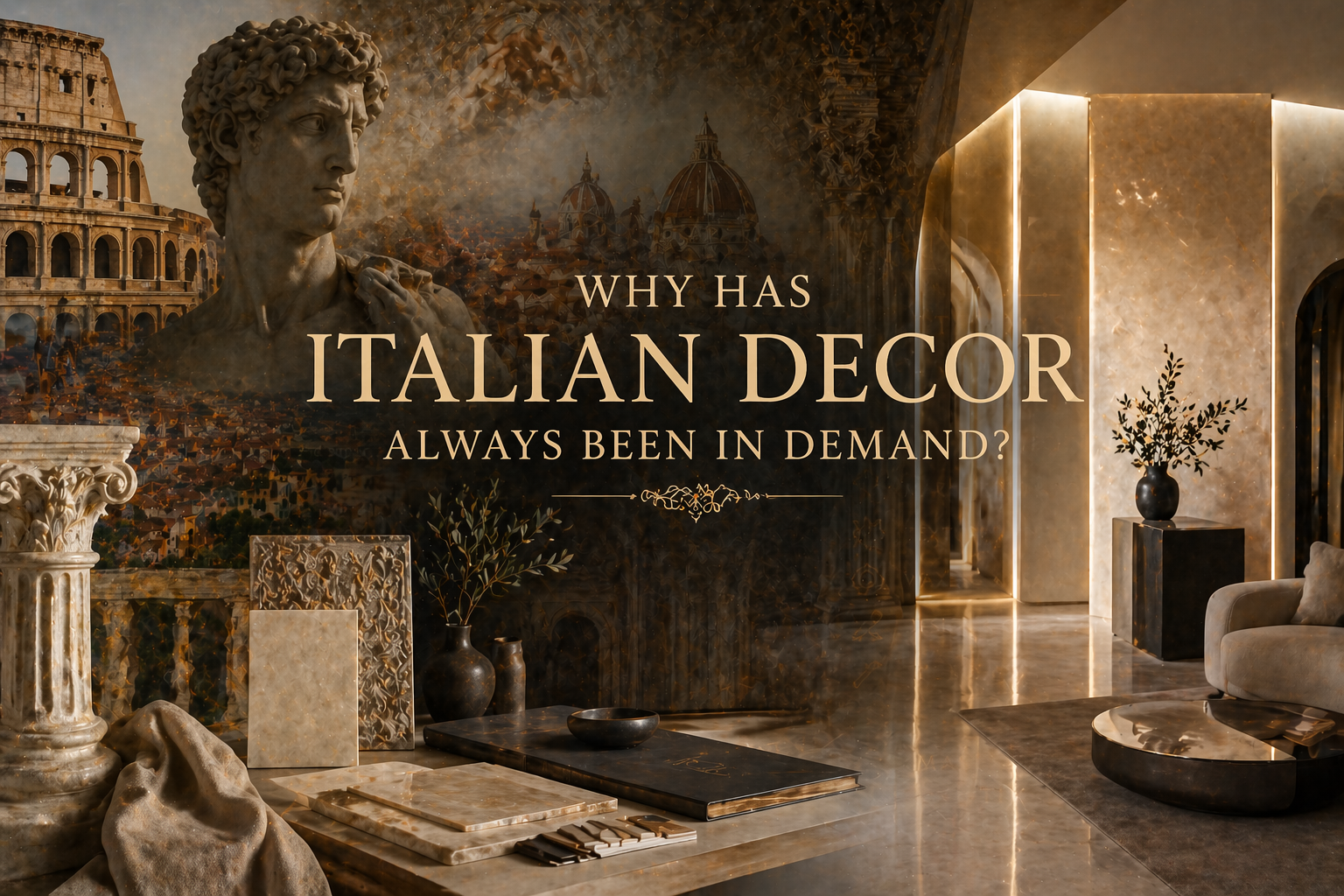
Why Has Italian Decor Always Been in Demand?
It’s a question that almost answers itself. To ask why Italian decor has always been in demand is to acknowledge a simple truth that its influence has stood the test of time. But to truly understand why, we need to take a step back and trace its origins.
When we say “always,” we’re not speaking in absolutes, but rather referring to the long-standing legacy of Italian design a history that stretches back to the foundations of civilisation itself.
Modern Italy may be relatively young, but its cultural roots run deep. At the heart of this story lies Ancient Rome — once the centre of the known world. It was a hub of power, wealth, and influence, where standards of living, architecture, and aesthetics were not only developed but exported across continents.
Where wealth gathers, culture follows. And where culture flourishes, design evolves.
Decoration, in its simplest form, is as old as humanity from early cave markings to structured architectural beauty. But what distinguished Rome, and later Italy, was the elevation of decoration into an art form. It became intentional, considered, and refined. No longer just functional, interiors began to reflect status, taste, and identity.
As time progressed, Italy continued to shape the world of design. After the fall of the Roman Empire, there was a period of quiet but not for long. By the 14th century, Italy once again took centre stage through the Renaissance a movement driven not by power, but by creativity. It redefined art, architecture, and interior aesthetics, setting a standard that would influence generations.
Then came Baroque bold, expressive, and unmistakably Italian in its origins. Once again, Italy led, and the rest of Europe followed.
Today, Italian décor continues to hold its position at the pinnacle of design. It represents more than just style — it embodies craftsmanship, heritage, and a deep understanding of beauty. It balances tradition with innovation, blending timeless materials with modern application.